
TDM is focussed on initiatives which aim to uplift the socio-economic status of our local communities. This includes not only investments in training and education, but also the development of infrastructure such as roads, access to public amenities, schools and access to basic healthcare through our estate health clinics which are manned by trained medical professionals.
Over the years, we upgraded 1,018.58 km of internal roads within our estates which helps expedite the movement of FFB from the estates to the mills. This has contributed positively to the CPO yield as shorter transportation time decreases the formation of Free Fatty Acid (FFA). FFA formation can be detrimental to the quality of the CPO.
The upgrading of internal roads has also helped smallholder farmers to transport their harvest safely and faster. It also helps to reduce vehicle repair costs.
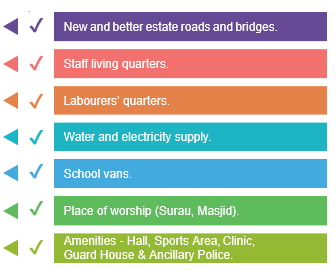
Other infrastructure and facilities which we have invested in our estates and mills are:
Employee Volunteering Programmes
We encourage all of our employees across the board and at every level of the organisation to support charity and social initiatives. Employee volunteer programmes forms a basis to build meaningful relationships with the local community while opening opportunities for improved engagement and gaining feedback.
Resettlement Matters
In 2018, we are pleased to report zero-resettlement.
Social Impact Assessment (SIA)
The Group also understands the significance of measuring social impact on the community in order to quantify the quality of the return of investment in our ventures. The Group engages a third-party assessor to conduct SIA where applicable.
Addressing Human Elephant Conflict (HEC)
HECs have increased over the years due to encroaching into the elephant’s natural territories through forest clearance for agricultural activities or crop raiding by the wild elephants. In a joint research project with University Malaysia Terengganu (UMT), recommended methods to mitigate HECs were established. The project was initiated in July 2018 and is still in progress until August 2019.
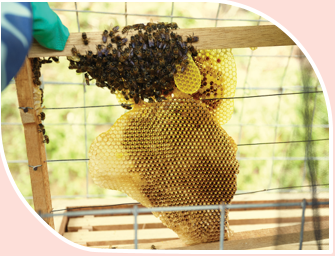
Through the research efforts, usage of honey bees as elephant repellent was introduced in two estates, Jernih and MAIDAM Estate, at areas of encroachment/intrusion entry.
The outcome of the research not only zoomed in on the reactive behaviour of wild elephants towards honey bees but also contributed towards an ecological balance in nurturing and sustaining the honey bee population at these sites. Honey bees are important pollinators in our environment to maintain biodiversity and vibrant ecosystems for plants.
With the increasing commercial value of honey, the bees that thrive at our plantations can lead in becoming a growing generator of income as a means of food security for small- scale producers and forest dwellers.


